
Research
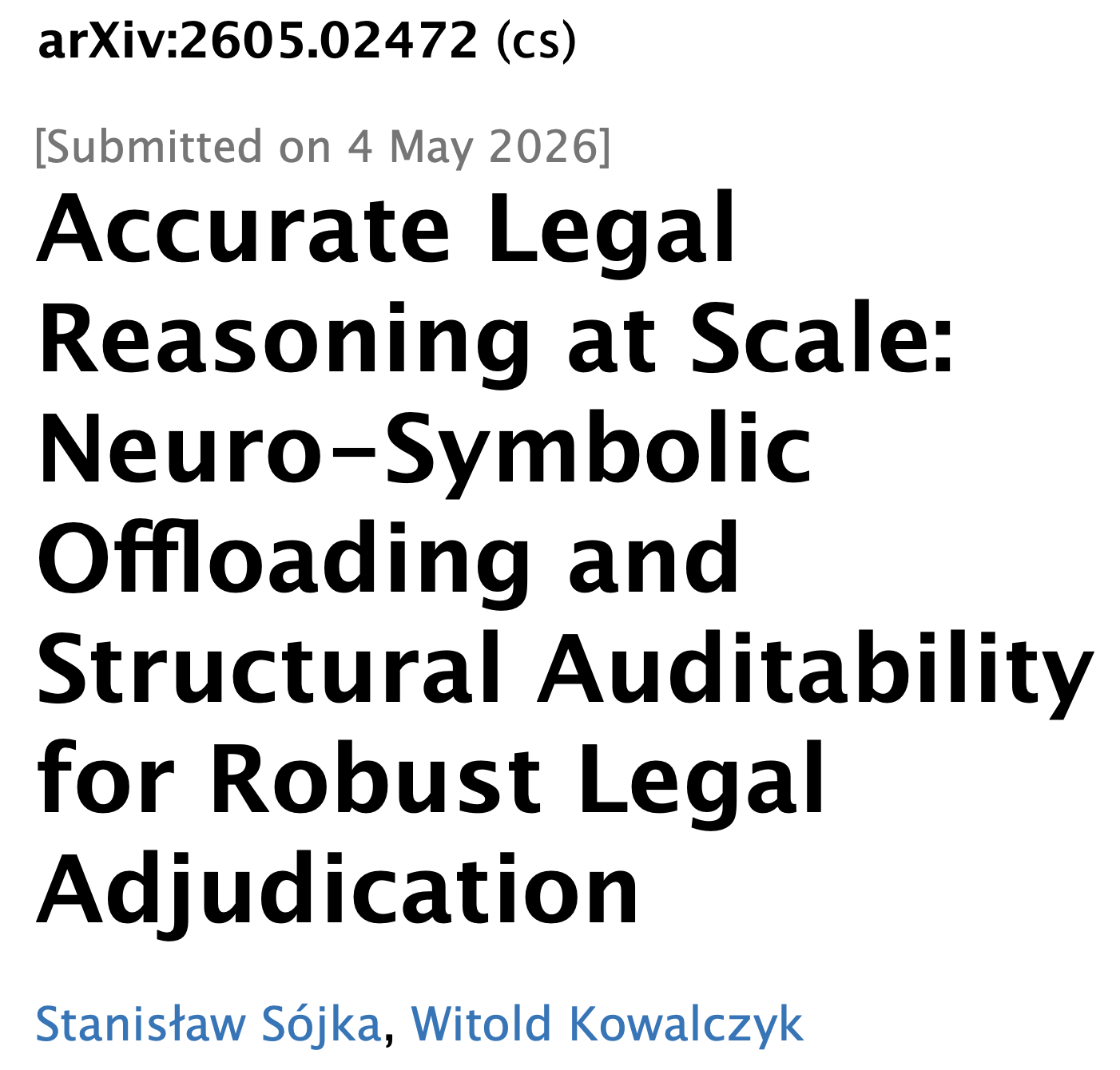
Our paper on Neuro-Symbolic AI for Legal Reasoning was accepted to ACL
Our latest research, accepted to ACL 2026, presents a neuro-symbolic AI framework for solving complex legal reasoning problems such as contract fulfillment by combining large language models with logical programming.
Research
Witold Kowalczyk, Stan SójkaWe're excited to share that our paper on neuro-symbolic AI for legal reasoning has been accepted to the Annual Meeting of the Association for Computational Linguistics (ACL), one of the leading conferences in natural language processing.
The paper is the result of more than 18 months of research and production work by Stan Sójka and myself. It explores how combining large language models with logical programming can produce reasoning systems capable of solving complex legal problems accurately and consistently.
Specifically, our work focuses on contract fulfillment.
We demonstrate that by combining AI with symbolic reasoning, it is possible to build systems that can read contracts, determine whether contractual obligations have been fulfilled, and automatically decide what should happen next—whether that is making a payment, applying a contractual penalty, escalating a dispute, or taking another contractual action.
Unlike purely generative AI systems, neuro-symbolic approaches offer deterministic reasoning over formal rules while retaining the flexibility of modern language models to understand legal documents written in natural language.
At Delos, we believe this type of technology is essential if AI is to meaningfully improve access to justice. Our goal is not simply to help lawyers work faster, but to build systems capable of solving legal reasoning problems autonomously, at massive scale, and with repeatable accuracy.
The greatest impact of legal technology will not come from assisting a handful of large law firms. It will come from making it economically viable to reason over the hundreds of millions of contractual obligations that businesses and individuals create every year.
This paper represents one step toward that vision.
You can read the paper here: